TWITTER

FB

PINTEREST

GOOGLEPLUS
LEFTHOMEREADER TEACHER AUTHORRESEARCHER MOTHERABOUT MERIGHT
HEADER BOTTOM LEFTHEADER BOTTOM RIGHT

Saturday, August 14, 2010

Some insights on the Slush Pile

Here is an excerpt from an interesting article about what writers should avoid when writing for small children.


Subjects that do NOT interest small children:
1. How cute small children are. Adults think children are cute and sweet and darling and innocent and all those sentimental things. Kids think they're people meeting challenges, accomplishing goals, all the things we think of ourselves.
2. What cute things small children say. Young readers can find an interesting approach or way of looking at things interesting, but they don't think of them as "cute." As soon as you feel an "awwww" about what you wrote, there's a good chance you're approaching it in a way a child won't like.
3. How much grandparents love small children -- especially specific small children. Kids are very interested in their own personal grandparents. Everyone else's grandparents are just old people. Kids are not overly interested in old people and how stray old people feel about kids.
4. How much moms and/or dads love small children -- especially specific small children. Kids are interested in their own person parents. They are interested in other people's parents only if they do really unique interesting things.
5. How much small children need to love/respect/appreciate parents and grandparents - children don't learn morality from stories, they learn it from the people in their lives who are important to them. Stories can subtly reinforce what a child is already learning, but that's about it. And it best be doing it while really entertaining the reader.
6. How to have nice manners. Whenever the main point of your story is a lesson, you're probably in deep trouble.
One side note on the "love" issue. There are many pictures books targeting adults, found in the children's section that are basically about how much adults love kids. There are some read-aloud stories in young children's magazines that are basically about how much adults love kids. The target audience for both is the adult, so you might want to decide if you're a children's writer or a writer for adults - unless you have something to say in a way that is totally going to sweep the reader away more than any other love story out there.
Now, a side note on "manners." You can possible get a really funny manners story through the pipeline. But know, one reason why editors are edgy about them is that adults are beginning to catch on that children don't learn manners from stories -- but that stories illustrating bad manners are great sources for ideas on how to freak out adults. However, a light look at etiquette can be of interest to tween girls, if the voice and approach is handled correctly. To date, virtually no boy has ever looked for a story on how to have nice manners -- at any age.
Subjects that give small children something new to worry about:
1. Anthropomophic animals that die at the end of the story in ways that seem funny to adults and teens. No matter how funny the talking mouse dies, a small child will cry when it happens - they relate to the mouse, not the killer.
2. Stories where children die in the story -- usually after a long illness. Most kids don't worry that getting sick will kill them. Editors prefer not to give them something new to worry about.
3. Stories where siblings die in the story. Generally a story that is going to make a young child cry aren't something magazine editors are desperate for because if you make a child cry or give it nightmares, somewhere a parent is going to unsubscribe from the magazine.
4. Stories where parents die in the story. Same reason.
5. Stories where grandparents die in the story.
6. Stories where children disobey their parents and die as a result. I know, some of the old folktales are full of characters who disobey authority and die as a result. Today, editors aren't looking for those kinds of fear-based morality tales.
7. Stories where children don't take good care of a pet, so it dies. Honest, this is not the correct way to teach kids to be responsible pet owners. I read one of these when I was a kid and I still remember how horrified I was. I probably fed my hamster to obesity as a result.
Are you seeing a trend here? Children who have experienced death can benefit from stories that help them deal with experience. But children who have not experienced death in their family or close sphere, don't tend to worry about death unless something comes along and injects the idea into their lives -- like a story. As a result, for ANY magazine story, your main character really needs to survive -- really. Editors won't buy stories that freak out children and encourage their parents to unsubscribe from the magazine. There are BOOKS for children that are designed to help them deal with death -- they are usually published by specialized publishers and even then, the main character is not the one who dies. 

May 13, 2010 by Jan Fields
"The Write Words to Read"
The Institute of Children's Literature

Friday, August 13, 2010

Maya Angelou's Wisdom

I mentioned this on facebook a while ago, but I watched many years ago an interview with Maya Angelou and Oprah and one of their conversations intrigued me.  They were  discussing how negative thoughts and conversely positive ones can affect not only the people around you but also the objects around you.  Have you ever walked into a place and immediately felt the "evil" or the "joy?"  Many have commented that concentration camps have a certain feeling.  Some have said hospitals are like that as well.  I always notice the tone at the airport.  Go to arrivals and sense the joy and go to departures and feel the sadness of goodbyes.

I decided one day that I wanted to read the transcript of it again.  Isn't the internet amazing?  So...


Oprah: And you also don't allow anybody to say anything negative about anybody while in your home.
Maya: That's right. 
Oprah: I've seen you put people out of your house for telling a racist joke! And you are not the least bit embarrassed about disrupting the whole room.
Maya: I believe that a negative statement is poison. The air between you and me is filled with sounds and images. If that were not so, how is it that I can turn on a television right now and see what's happening in New York? That means sounds and images are in the air, crowded, jammed up like bats. And Oprah, I'm convinced that the negative has power. It lives. And if you allow it to perch in your house, in your mind, in your life, it can take you over. So when the rude or cruel thing is said—the lambasting, the gay bashing, the hate—I say, "Take it all out of my house!" Those negative words climb into the woodwork and into the furniture, and the next thing you know they'll be on my skin. 
Oprah: The same is true with the positive spirit.
Maya: I believe so. Oprah: You can allow goodness to come in, and you can claim it.
Maya: You can ask it in, show it how much you like it, make room for it. And it says, "Oh, I like this place, I think I'll stay here." Which is why people go into one house and say, "I want to take my shoes off." At another house, no matter how beautiful it is, they might say, "Hmm, I can't stay."
Oprah: All of your principles stem from knowing who you are, because when you know who you are, you can say to people, "That will not happen in my home."
Maya: That's right—and if I'm in someone else's home, I will leave. And I'm really not sorry. 
O, The Oprah Magazine  |  December 15, 2000

Thursday, August 12, 2010

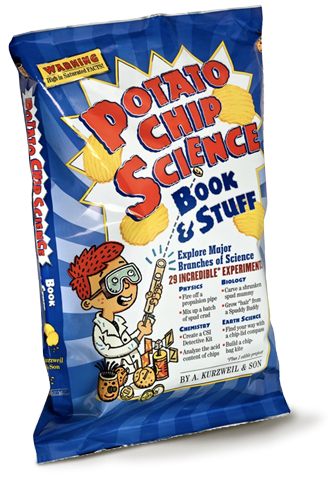
Potato Chip Science Book and Stuff

Ever heard of the author Allen Kurzweil?  He wrote Leon and the Spitting Image and Leon and the Champion Chip.  It was during Kurzweil’s tour for the Leon books when he learned that educators just assumed that the experiments the teacher conducts in Champion Chip weren’t possible, that he decided to work with his son to create a science kit for kids and teachers based on chips: Potato Chip Science Book & Stuff (Workman, Sept.).

To get started, says Kurzweil, “we transformed our basement into a research facility. Much to the consternation of my wife, it became a junk food paradise.” Kurzweil and Max taste-tested a variety of chips and then created experiments using them, as well as the containers—potato chip bags, lids, and tubes. Not every experiment, like the ant colony, made it into the finished kit. Some were rejected because they were too complicated to replicate or to obtain the materials. But the shrunken potato head, the pocket-sized propulsion pipe, and the CSI Detective Kit all made the cut.

While Kurzweil and Max researched the book, they faced a more difficult problem: how to manufacture the kit so that the book and all the other pieces would fit into a potato chip bag. Plus Kurzweil and Max wanted to make Potato Chip Science here in the U.S. with eco-friendly components, unlike other science kits, which are primarily produced in Asia. In fact the manufacturing issue was so knotty that the book was ready a full year before the rest of the kit, despite father and son putting in annual visits to SNAXPO, the trade show for snack food professionals, where Kurzweil and Max asked lots of manufacturing questions.

For Kurzweil, the manufacturing conundrum was one of the most pleasurable parts of the project because it enabled him, he says, to tap into a previously unknown desire to make things. His father was an industrial designer and inventor; his cousin Ray Kurzweil was called “the rightful heir to Thomas Edison” by Inc. magazine.

Despite the necessity—for the sake of research—of eating a lot of chips, Kurzweil, who is currently a fellow at the John Carter Brown Library at Brown University, was forced to cut back. The research threw his triglyceride count off the charts. Nor does he have a favorite chip. Like novels, he says, “I can’t see living with just one.” Max, who is now 16 and will be a junior at The Wheeler School in Providence, R.I., continues to munch at will.

As for Potato Chip Science, it proved to be a popular giveaway at this spring’s SNAXPO. It’s also been a hit with booksellers. After an initial print-run of 35,000 copies, Workman is planning to go back to press next week, according to senior publicist Oleg Lyubner. And that’s before Kurzweil embarks on a two-month book tour starting in mid-September at the Smithsonian in Washington, D.C. He will also visit Nashville, St. Louis, Minneapolis, New York City, Philadelphia, Cincinnati, Chicago, Salt Lake City, Seattle, and Phoenix.
taken from PW
Chipping Away at Science: Turning the Humble Potato Chip into a Scientific Experiment 
By Judith Rosen 
Jun 24, 2010

Wednesday, August 11, 2010

Wanna check out a new site for writers?

I don't know much about this but it looks interesting.  If you want to write, and have industry experienced people guide you in the right direction...then try these gals.

http://paperlanternlit.com/

Tuesday, August 10, 2010

Online Storytime with Barnes & Noble


Parents of picture-book readers needn’t leave home to enjoy story time with their children. This week, Barnes & Noble.com debuted its Online Storytime program, videos featuring pan-and-scan filming of picture books accompanied by readings by authors or celebrities. A new Online Storytime entry will be added to the site on the first Tuesday of each month. The inaugural offering features Jane O’Connor narrating her Fancy Nancy: Bonjour, Butterfly (HarperCollins) along with displays of Robin Preiss Glasser’s illustrations.
Rachel Jarrett, director of kids and lifestyle products for Barnes & Noble.com, explains that Online Storytime was created “to give our customers the same great experience online that they have with their children at our in-store B&N Storytimes. That is a magical experience, and we wanted to capture some of that magic and make it available 24 hours a day.”
The titles spotlighted on the site are selected by collaborative effort among Jarrett, members of her department, and production staffers who create the videos. Jarrett calls Fancy Nancy: Bonjour Butterfly “a perfect story for the program’s launch, since it has a springtime theme, is fun and entertaining, and its artwork is so beautiful—it almost tells the story on its own.”
She notes that Fancy Nancy is among B&N’s most popular picture-book series, as is Jon Scieszka’s Trucktown, which is the second Online Storytime selection. Beginning on July 6, visitors to the site can listen to the author reading his Smash! Crash! (Simon & Schuster) and watch Jack Truck and Dump Truck Dan smashing and crashing in illustrations created by David Shannon, Loren Long, and David Gordon.
“At the end of the day, the goal of both our in-store story times and Online Storytime is to encourage a love of reading in children,” says Jarrett. “It is great to be able to do this two ways.”
By Sally Lodge 
Jun 04, 2010